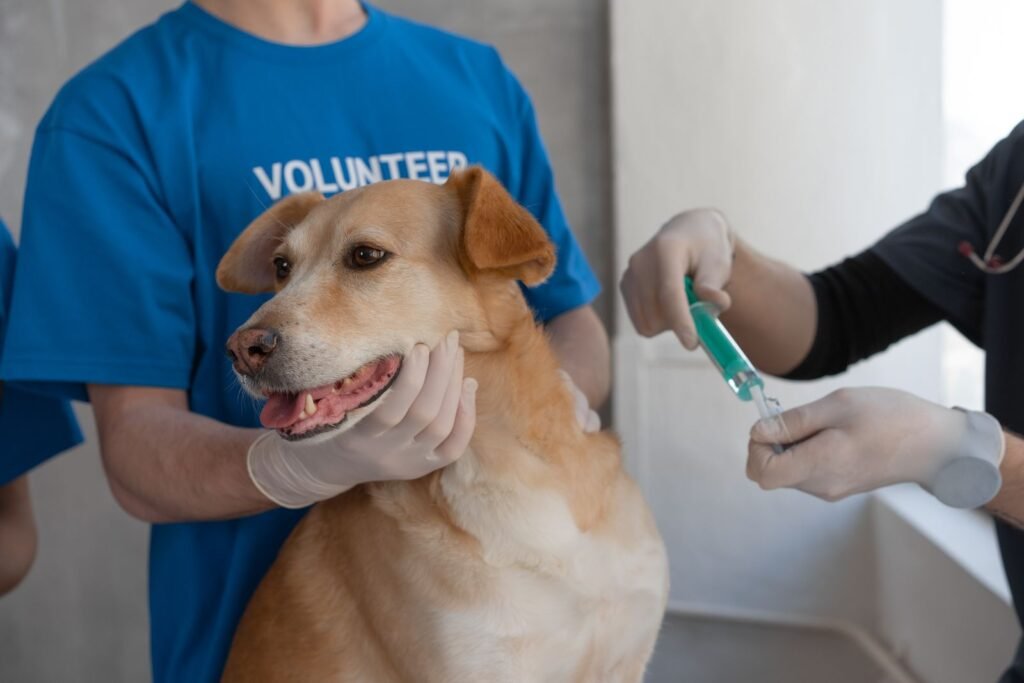
The dog vaccination cost in the USA is usually $27 to $96 per vaccine, according to CareCredit’s national averages. The most common averages are about $42 for DHPP, $35 for rabies, $34 for leptospirosis, $38 for Bordetella, $53 for canine influenza and $50 for Lyme disease. A puppy needs a series, not one visit: the vaccines alone for a core puppy plan come to roughly $229, and the first-year total at a private vet is usually $250 to $500 — $100 to $250 at a low-cost clinic.
What each dog vaccine costs
Prices vary by vaccine, clinic type and state, so treat every figure below as a national planning average, not a quote. CareCredit’s 2026 averages anchor this table; the ranges beside them come from published 2026 guides.
| Vaccine | What it protects against | CareCredit average | Typical range (2026 guides) |
|---|---|---|---|
| DHPP / DAPP (5-in-1) | Distemper, adenovirus, parainfluenza, parvovirus | $42 per dose | $20–$65 |
| Rabies | Rabies | $35 per dose | $15–$45 |
| Leptospirosis | Leptospira bacteria | $34 per dose | $25–$62 |
| Bordetella | Kennel cough | $38 per dose | $20–$54 |
| Canine influenza | Dog flu | $53 per dose | $30–$65 |
| Lyme disease | Lyme disease | $50 per dose | $25–$60 |
The range is the point: the same DHPP dose can cost $25 at one clinic and $65 at another. Location matters too — city-level data reported by MetLife put rabies at about $36 in Los Angeles, $34 in Chicago and $33 in Houston.
Core vs non-core: which vaccines your dog actually needs
Not every vaccine is for every dog. The American Animal Hospital Association (AAHA) 2022 Canine Vaccination Guidelines divide vaccines into core — for nearly every dog — and non-core, given only when a dog’s lifestyle and risk justify them.
Core vaccines are distemper, adenovirus and parvovirus (given together as the DHPP or DAPP combination), rabies, and leptospirosis. Leptospirosis joined the core list in the 2022 guidelines, because the disease has become more common and almost any outdoor dog is exposed to it. Rabies is also fixed in state law in most of the USA.
Non-core vaccines are Bordetella (kennel cough), Lyme disease, canine influenza and the rattlesnake vaccine. Your vet adds these only if your dog’s risk profile justifies them: Bordetella for daycare or boarding dogs, Lyme for dogs in tick-heavy areas, canine influenza where outbreaks occur or boarding requires it.
Dog vaccination cost for puppies: the series, visit by visit
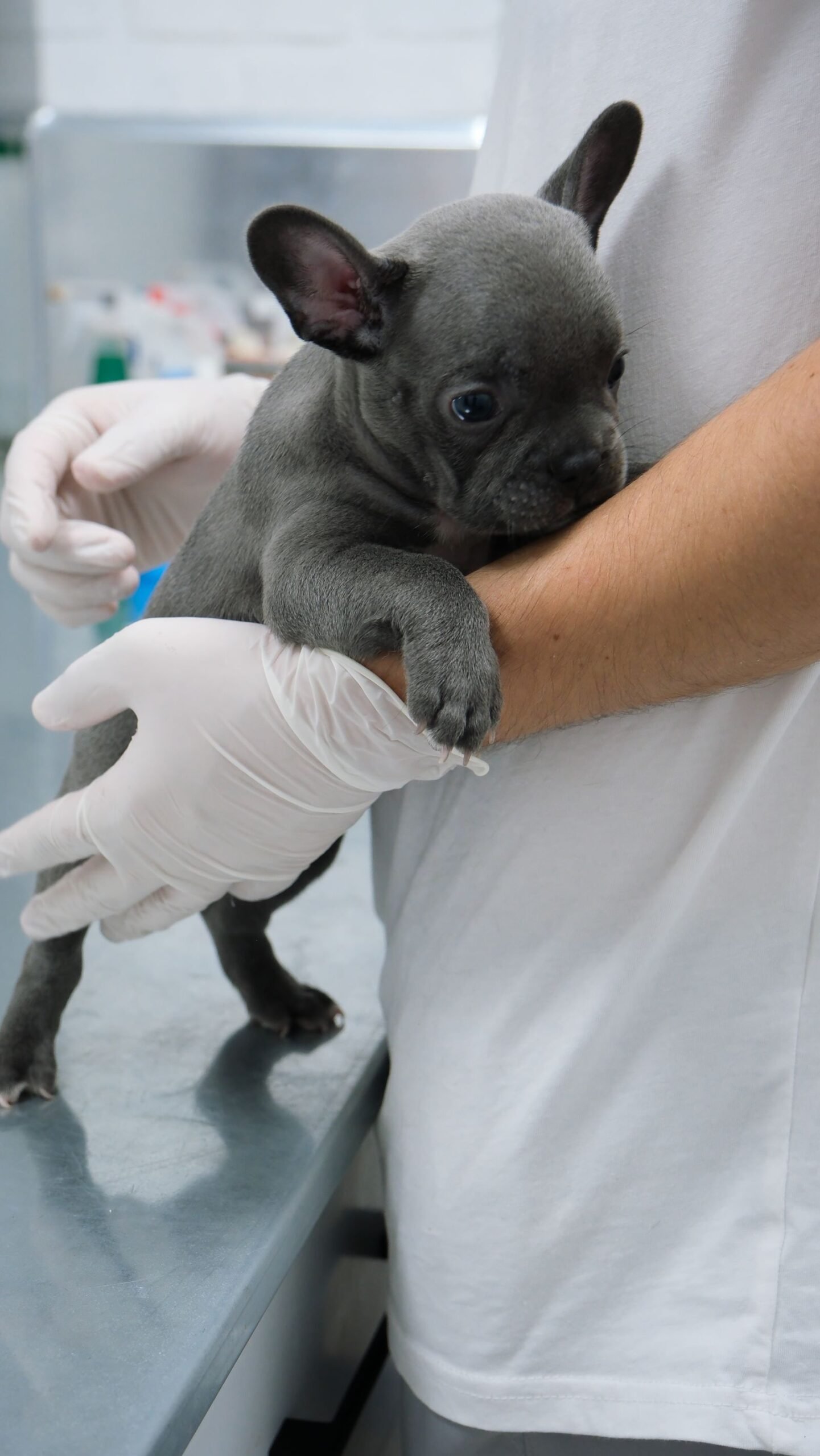
Puppies need a series rather than one injection, because antibodies passed from the mother fade between 6 and 16 weeks of age. The AAHA guidance starts the distemper, adenovirus and parvovirus combination at 6 to 8 weeks, with doses repeated every 2 to 4 weeks until the puppy is older than 16 weeks — at least three DHPP doses in total.
| Puppy age | Vaccines at the visit | What it costs (vaccines only, CareCredit averages) |
|---|---|---|
| 6–8 weeks | DHPP round 1 | About $42 |
| 10–12 weeks | DHPP round 2 + leptospirosis round 1 | About $42 + $34 = $76 |
| 14–16 weeks | DHPP round 3 + leptospirosis round 2 + rabies | About $111 |
| 12 months | DHPP booster (+ rabies where required) | About $42 (+ $35) |
Using those averages, a sample core puppy plan — three DHPP doses, two leptospirosis doses and one rabies vaccine — costs about $229 for the vaccines alone. Low-cost packages put a three-round puppy series at about $180 to $215 in total: one provider publishes three puppy packages of $45, $65 and $70, and ShotVet lists a three-round Puppy Club at $215. A Vetco location in Houston lists a $269 puppy bundle with the same core vaccines plus Bordetella, deworming, a fecal test and vitals checks.
How much do puppy shots cost in total, then? Chewy’s veterinary experts put a complete first-year series at $100 to $300 or more for the vaccines alone. Once exam fees are added at a private vet — $50 to $100 per visit — a realistic first-year total is $250 to $500; at low-cost clinics, about $100 to $250. GreatPetCare puts the puppy series at $300 to $400 including boosters at a private vet. Budget $250 to $500 for the first year at a private vet, less at a low-cost clinic.
How often do dogs need vaccines? Adult boosters
The puppy series is the expensive part; adult boosters are cheaper, because most vaccines are not needed every year. The usual pattern is a DHPP booster at 12 months and then every 3 years; rabies every 1 or 3 years, depending on the product and your state’s law; leptospirosis every year; Bordetella every 6 months to yearly; and canine influenza and Lyme yearly, where risk justifies them.
An adult dog’s yearly vaccines therefore cost far less than a puppy’s first year. Published 2026 guides put annual adult boosters at $35 to about $355–$375 a year, depending on which vaccines are due — a year when only DHPP and rabies are due costs little, while a year when leptospirosis, Bordetella, Lyme and influenza are all due costs several times more.
Dog vaccination cost without exam fee — and with it
The exam fee is the hidden half of the vaccination bill. At a private vet, a routine vet visit cost is $56 to $129 for a dog at national averages (CareCredit/Synchrony), and the exam fee alone is commonly $50 to $100. A puppy series means three visits, so three exam fees can add $150 to $300 — which is exactly why the same vaccines cost $250 to $500 at a private vet and $100 to $250 at a low-cost clinic.

Low-cost clinics work differently: Vetco at Petco runs weekend walk-in clinics with no exam fee, most vaccines at $35 to $55 and rabies around $35, and VIP Petcare lists vaccines at $29 to $45 with no office fee. Shelter clinics often charge as little as $10 for a rabies shot. The vaccine is the same product; what changes is the setting and the exam. If your dog is healthy and only needs vaccines, a low-cost clinic is usually the cheapest option. If your dog has a health problem, a private vet visit is the right place, because the exam is what finds it.
Pet insurance does not usually cover vaccines in a standard accident-and-illness plan; routine care is covered only by a separate wellness add-on, which costs extra — see our guide to pet insurance cost. A vet clinic’s own wellness plan can be cheaper than paying per visit, but only if you would use everything in it.
What’s new in 2026: parasites and a new rabies vaccine
Two November 2026 developments are worth knowing about, though neither has yet changed what a vaccine costs: First, the American Animal Hospital Association released the 2026 AAHA One Health Guidelines on emerging parasites on 29 October 2026, identifying 12 parasites of greatest concern in North America — including drug-resistant canine hookworm and New World screwworm — and introducing antiparasitic drug stewardship. Your vet may ask more about where your dog travels, rather than prescribing the same prevention for every dog. Second, Merck Animal Health announced on 2 November 2026 the US availability of NOBIVAC NXT 1-Rabies and NOBIVAC NXT 3-Rabies, next-generation rabies vaccines for healthy dogs and cats 12 weeks of age or older, with a three-year duration of immunity after a repeat dose for the 3-Rabies version. Merck did not disclose pricing, so ask your vet which rabies product the clinic uses and whether it is a 1-year or 3-year vaccine.
See a vet now if… your dog has swelling of the face or muzzle, trouble breathing, sudden weakness or collapse, repeated vomiting, or pale gums after a vaccination, or if a puppy has bloody diarrhoea, refuses food and water, or becomes very lethargic. This is general information only, not a substitute for veterinary advice. Do not try to treat these signs at home — contact a vet or emergency clinic immediately. No drug dosages or treatment instructions are given in this article.
How to keep the vaccination bill down without cutting corners
- Ask for the package price before booking. A three-visit puppy package is usually cheaper than paying per vaccine per visit.
- Use a low-cost clinic for vaccines alone. If your dog is healthy and only needs shots, Vetco, VIP Petcare and shelter clinics charge no exam fee.
- Keep the series on schedule. Missing a dose can mean starting part of the series again.
- Ask which vaccines are due. Non-core vaccines are for risk, not routine.
- Budget the first year separately. A puppy’s first year bundles the most visits — see our guide to the cost of owning a dog. A large breed such as a Labrador also costs more across its life — read our guide to Labrador Retriever lifespan before you budget for one.
FAQ
How much do puppy shots cost?
The vaccines alone for a core puppy plan — three DHPP doses, two leptospirosis doses and one rabies vaccine — cost about $229 at CareCredit’s averages. With exam fees at a private vet, the first-year total is $250 to $500; at a low-cost clinic, about $100 to $250.
How much does a dog vaccination cost per shot?
Usually $27 to $96 per vaccine (CareCredit). Common averages are about $42 for DHPP, $35 for rabies, $34 for leptospirosis, $38 for Bordetella, $53 for canine influenza and $50 for Lyme disease.
How much does a dog vaccination cost without an exam fee?
At low-cost clinics such as Vetco or VIP Petcare, most vaccines cost $29 to $55 with no office fee, and rabies can be as little as $10 at a nonprofit clinic. At a private vet, add a $50 to $100 exam fee per visit.
How often do dogs need vaccines?
Puppies need at least three DHPP doses between 6 and 16 weeks, plus leptospirosis and rabies. Adults usually get a DHPP booster at 12 months and then every 3 years, rabies every 1 or 3 years, and leptospirosis every year.
Which dog vaccines are core?
Under the AAHA 2022 guidelines, the core vaccines are distemper, adenovirus and parvovirus (the DHPP combination), rabies and leptospirosis. Bordetella, Lyme disease, canine influenza and rattlesnake vaccines are non-core.
Does pet insurance cover dog vaccinations?
Not in a standard accident-and-illness plan — routine vaccines are usually covered only by a separate wellness add-on. See our guide to pet insurance cost.
Sources
- CareCredit (Synchrony), “Dog and Puppy Vaccination Schedule: When to Get What Shots” (reviewed by Dr. Kathy Wiederkehr, V.M.D., 24 Apr 2026) — https://www.carecredit.com/well-u/pet-care/vaccination-timeline-for-dogs-and-puppies/ — national average $27–$96 per vaccine; DHPP $42, rabies $35, leptospirosis $34, Bordetella $38.
- Money.com, “How Much Are Dog Shots?” (updated 19 Aug 2026) — https://money.com/how-much-do-dog-vaccinations-cost/?amp=true — per-shot range $20–$60; rabies $35, DA2PPv $42, Bordetella $38, leptospirosis $34, per CareCredit.
- The Pricer, “How Much Do Dog Vaccinations Cost?” (updated 19 Sep 2026) — https://www.thepricer.org/dog-vaccination-cost/ — $27–$96 per vaccine; rabies $35, DHPP $42, leptospirosis $34, Bordetella $38, canine influenza $53, Lyme $50; puppy series $180–$215 at low-cost providers.
- DogExpertise, “How Much Do Puppy Shots Cost? 2026 Price Guide” — https://www.dogexpertise.com/how-much-do-puppy-shots-cost-2026/ — core puppy plan (3 DHPP, 2 leptospirosis, 1 rabies) about $229 at CareCredit averages; Vetco Houston $269 puppy bundle.
- Chewy, “Dog Vaccines: How Much Do Dog Vaccinations Cost?” — https://www.chewy.com/education/dog/health-and-wellness/dog-vaccines-how-much-do-dog-vaccinations-cost — $27–$96 per vaccine; first-year series $100–$300 or more; DHPP $20–$50, rabies $20–$70, leptospirosis $30–$60, Bordetella $20–$50.
- GreatPetCare, “How Much Do Puppy Shots Cost?” (updated 29 Sep 2026) — https://www.greatpetcare.com/new-dog/how-much-do-puppy-shots-cost/ — puppy series $300–$400 including boosters at a private vet; distemper $40–$50, leptospirosis $30–$50, rabies $30–$60, Bordetella $20–$40.
- PetCare-AI, “Puppy Vaccination Cost in the USA (2026)” — https://www.petcare-ai.com/guides/puppy-vaccination-cost-usa — core series $150–$300 vaccines alone at a private practice; $250–$500 with exam fees; $100–$250 at low-cost clinics.
- Pet Health Answers, “Dog Vaccination Cost Guide (2026)” (1 Aug 2026) — https://www.pethealthanswers.com/articles/dog-vaccination-cost-guide — first-year puppy vaccinations $75 to about $390–$410+; annual adult boosters $35 to about $355–$375.
- AAHA, 2022 Canine Vaccination Guidelines — https://www.aaha.org/resources/2022-aaha-canine-vaccination-guidelines/ — core vaccines distemper, adenovirus, parvovirus, rabies, leptospirosis; Bordetella, Lyme and canine influenza risk-based.
- AAHA, 2026 One Health Guidelines: Emerging Concerns in Canine and Feline Parasitology (released 29 Oct 2026), as reported by Today’s Veterinary Business — https://todaysveterinarybusiness.com/aaha-releases-guidelines-on-emerging-parasites/ — 12 emerging parasites of greatest concern, plus nine of potential concern; antiparasitic drug stewardship.
- Merck Animal Health, “Merck Animal Health Launches NOBIVAC NXT Rabies for Dogs and Cats in the United States” (2 Nov 2026) — https://www.merck-animal-health-usa.com/newsroom/merck-animal-health-launches-nobivac-nxt-rabies-for-dogs-and-cats-in-the-united-states/ — NOBIVAC NXT 1-Rabies and 3-Rabies for healthy dogs and cats 12 weeks or older; 3-year duration of immunity after a repeat dose; non-adjuvanted, 0.5 mL dose; pricing not disclosed.
- dvm360, “Merck Animal Health launches nonadjuvanted rabies vaccines for dogs and cats as human exposures rise” (3 Nov 2026) — https://www.dvm360.com/view/merck-animal-health-launches-nonadjuvanted-rabies-vaccines-for-dogs-and-cats-as-human-exposures-rise — launch follows CDC health advisory on rising human rabies exposures.
- CareCredit (Synchrony), “How Much Does a Vet Visit Cost?” — https://www.carecredit.com/well-u/pet-care/emergency-vet-visit-cost-and-veterinary-financing/ — routine dog visit $56–$129; exam fee commonly $50–$100.
Last reviewed: 15 November 2026. This article is general information only and is not a substitute for veterinary advice.