
The Persian cat price in the USA for a pet-quality kitten from a reputable, health-testing breeder is usually $1,200 to $3,000 in 2026, according to Petful’s 2026 price guide, while adoption through a Persian rescue usually costs $150 to $450. Show-quality kittens from proven lines start around $3,500 and can pass $5,000. But the kitten price is the smallest part of the story: the first year, purchase included, typically totals $3,235 to $8,160, and the monthly cost after that runs about $315 to $430 — the highest of any common cat breed — because a Persian’s coat needs daily care and professional grooming. Persians are one of the oldest and most recognisable cat breeds in America, and also one of the most expensive cats to keep.
Persian cat price at a glance (2026)
| What you are paying for | Typical range (2026) |
|---|---|
| Breeder kitten, pet quality | $1,200–$3,000 |
| Breeder kitten, health-tested lines | $1,500–$3,500 |
| Breeder kitten, show quality | $3,500–$5,000+ |
| Top bloodlines, rare colours | $6,000+ |
| Adoption, breed rescue | $150–$450 |
| Adoption, shelter | $75–$600 |
| First year, purchase included | $3,235–$8,160 |
| Monthly cost after year one | $315–$430 |
| Professional grooming, per session | $60–$150 |
Sources differ a little on the breeder range because they measure different things. Petful’s 2026 guide puts a pet-quality kitten at $1,200 to $3,000; ThePricer’s September 2026 review of live US listings puts health-tested litters at $1,500 to $3,500, with current companion-kitten listings clustering near $1,700 to $3,000; and Hepper’s January 2026 guide gives a broader $1,000 to $5,000 for reputable breeders.
What moves the price: quality, colour and face type
Quality tier is the biggest price driver. A pet-quality kitten is sold on a spay or neuter contract, with registration papers, and is not intended for showing or breeding. A show-quality kitten from a proven line — with the flat face, heavy coat and conformation judges reward — starts around $3,500 and can pass $5,000, with top bloodlines and rare colours reaching $6,000 or more, according to CostlyPets’ November 2026 price guide.
| Quality tier | Typical price | What you get |
|---|---|---|
| Pet quality, registered breeder | $1,200–$3,000 | Healthy companion kitten, spay/neuter contract, papers |
| Health-tested lines | $1,500–$3,500 | Same, plus PKD-tested parents and screening records |
| Show quality, proven lines | $3,500–$5,000+ | Show potential, full registration, breeding rights possible |
| Top bloodlines, rare colours | $6,000+ | Rare colours, champion pedigree |
Colour matters, but less than quality. Petful’s 2026 pet-tier figures put standard colours — blue, black, red and classic tabby — at about $1,200 to $1,800, with silver, golden, shaded and smoke colours higher. The Cat Fanciers’ Association divides Persians into seven colour divisions: solids, tabbies, silver and goldens, shaded and smokes, parti-colours, calicos and bi-colours, and Himalayans (the pointed division, shown as part of the Persian breed since 1984).
Face type matters for health, not just looks. Persians range from the traditional “doll-face” with a longer nose to the very flat-faced modern show type, sometimes called peke-face. The flatter the face, the higher the risk of breathing trouble, tear-duct problems and dental crowding — and the higher the vet bills that follow. A breeder who charges a premium for the flattest face is charging for fashion, not health.
Adoption: the cheapest way to get a Persian
Adopting a Persian usually costs $150 to $450 through a breed rescue, according to ThePricer, and $75 to $600 through a shelter, according to 2026 adoption guides. Published rescue fees follow one pattern: the Persian and Himalayan Cat Rescue charges $275 to $450, and South Texas Persian Rescue charges $150 to $275, with basic veterinary care usually included. The fee usually covers first vaccines and spay or neuter — always ask before paying for them again at your vet.
The first year: what it really costs
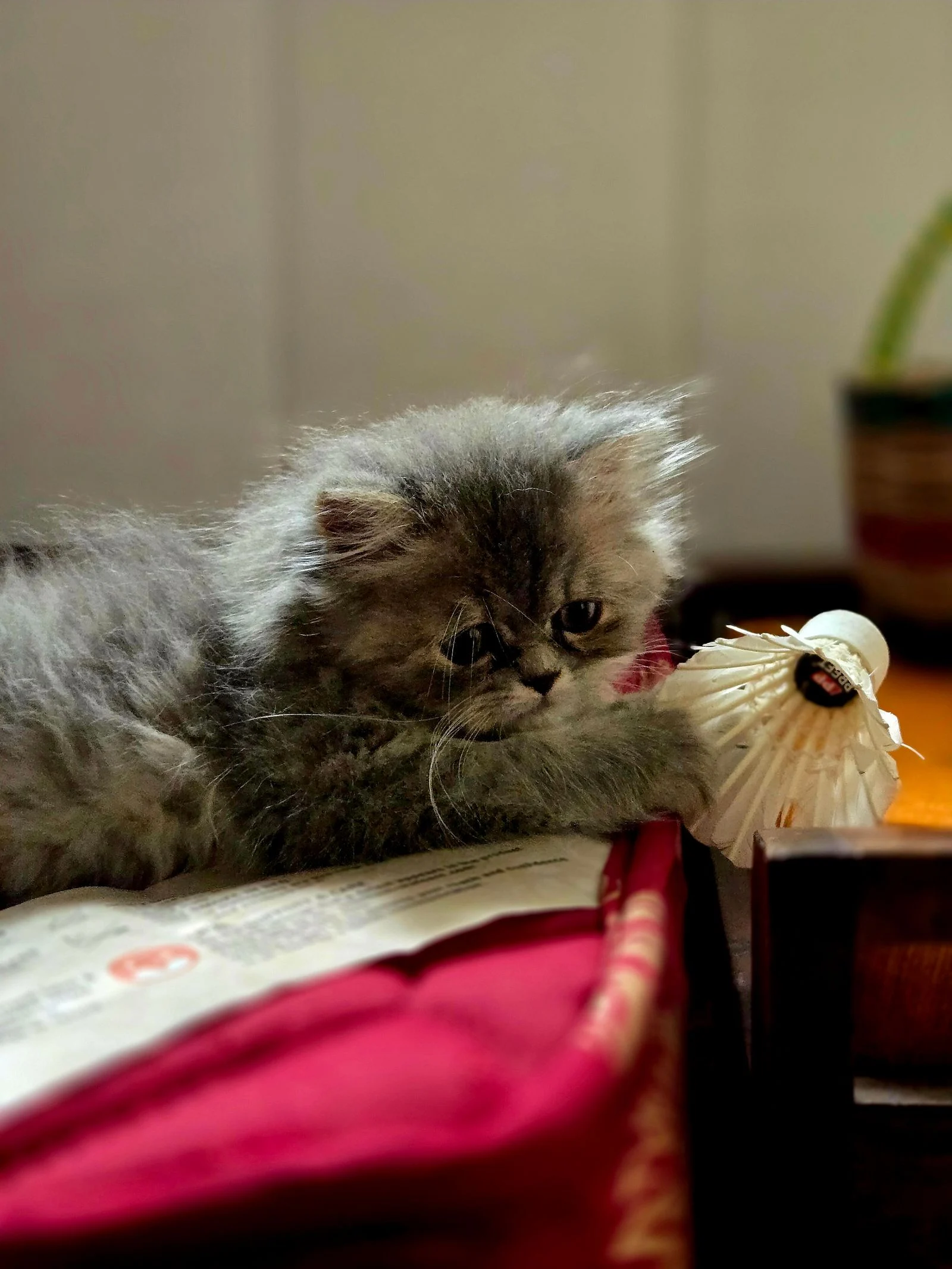
A Persian’s first year costs about $3,235 to $8,160 with a breeder kitten, according to Petful, while ThePricer’s itemised scenario, using an $1,800 kitten, comes to about $3,500 to $5,500 or more. The kitten price is the biggest single line, but grooming is the line that surprises new owners: it starts in month one, not year two.
| First-year item | Typical cost |
|---|---|
| Kitten from a breeder (or adoption fee) | $1,200–$3,500 ($150–$450 rescue) |
| First vet visits + kitten vaccine series | $150–$350 |
| Spay or neuter | $50–$250 (low-cost clinic) to $300+ (private vet) |
| Grooming tools + first salon visits | $200–$600 |
| Carrier, litter boxes, scratcher, bowls, bed | $200–$800 |
| Food, litter and supplies, first year | $300–$600 |
| First-year total, breeder kitten | $3,235–$8,160 |
The vaccine series is a real line item: our guide to cat vaccination cost puts the full kitten series at $150 to $350 across two to three visits. A routine vet visit cost for a cat, with core vaccines, is about $150 to $225 a year — the cheapest vet line in this article, and the one that catches the expensive problems early.
Persian cat price per month — and why it is the highest of any common breed
After the first year, a Persian costs about $315 to $430 a month, according to Spot’s 2026 estimate, once food, litter, grooming, insurance and routine vet care are counted. That is roughly double the monthly cost of an ordinary indoor cat, and grooming is the reason: no other popular breed needs this much coat care.
| Recurring cost | Monthly | Basis |
|---|---|---|
| Food (quality dry + wet) | $40–$80 | Larger appetite than a small cat, premium food common |
| Litter | $20–$35 | Long coat tracks litter; more changes |
| Professional grooming | $60–$150 per session | Salon care every 4–8 weeks, or daily home brushing |
| Routine vet care, saved monthly | $15–$30 | Yearly exam, boosters, bloodwork |
| Pet insurance | $30–$40 | NAPHIA cat average about $386 a year (2024) |
| Treats, toys, supplies | $15–$30 | Combs, eye wipes, hairball care |
| Total per month | $315–$430 | About $3,800–$5,200 a year |
The full yearly picture for any cat is in our guide to the cost of owning a cat, which puts a healthy indoor cat at $1,000 to $2,450 a year — a Persian sits well above that range, mostly because of grooming. Insurance prices are in our guide to pet insurance cost.
How long do Persian cats live?
The honest answer is a spread, not a single number. Wisdom Panel lists 12 to 17 years, Everypaw lists 12 to 16 years, and a Royal Veterinary College study of 3,235 Persians under UK general-practice care found a median lifespan of 13.5 years, with kidney disease the most common grouped cause of death. The gap is mostly decided by kidney health: a Persian from PKD-tested parents, kept indoors and seen by a vet every year, is the one most likely to reach the top of the range.
Health watch-points that change the real cost
A Persian’s purchase price is not its real price. The breed’s health problems are common enough that they should be budgeted for from day one.
- Polycystic kidney disease (PKD). The most important Persian health issue. PKD is an inherited, autosomal dominant condition caused by a mutation in the PKD1 gene: fluid-filled cysts grow in the kidneys over the cat’s life and eventually cause kidney failure. Historically, studies found the gene in about 36% to 49% of Persians worldwide, according to the Universities Federation for Animal Welfare, and a 2001 University of Sydney study found it in 45% of Persians scanned in Sydney and 42% in Brisbane. The Cat Fanciers’ Association says PKD is now being well controlled with genetic testing and desexing of affected cats — which is why the single most important document a breeder can show you is a negative PKD1 DNA result for both parents. Cats can be DNA tested at any age with a cheek swab, and cysts can be seen on ultrasound from about 10 months of age, according to the Cornell Feline Health Center.
- Brachycephalic airway problems. The flat face narrows the airways, so Persians can struggle to breathe, especially in heat or after exertion. The same flat face crowds the teeth and blocks the tear ducts, so watery eyes and dental problems are common.
- Progressive retinal atrophy (PRA). An inherited eye disease that causes vision problems early in life — from 4 to 8 weeks of age in Persians, progressing rapidly, according to breed health guides. Reputable breeders test for it.
- Hypertrophic cardiomyopathy and urinary problems. Persians are also at higher risk for heart muscle disease and feline lower urinary tract disease, according to Basepaws’ breed profile.
See a vet now if… your Persian is struggling to breathe, breathing with its mouth open, has collapsed or cannot stand, has not urinated for a day, is vomiting repeatedly, or shows sudden blindness or severe lethargy. This is general information only, not a substitute for veterinary advice. Do not try to treat these signs at home — contact a vet or emergency clinic immediately. No drug dosages or treatment instructions are given in this article.
Grooming: the daily commitment buyers underestimate
A Persian’s coat is the reason most owners buy the breed — and the reason most new owners underestimate the work. The long, dense double coat mats if it is not brushed down to the skin every day, and a matted coat is not a cosmetic problem: it pulls the skin, hides sores, and can end in a vet visit to shave the mat out under sedation. Professional grooming runs about $60 to $150 per session, according to ThePricer, and most owners who use a salon go every 4 to 8 weeks. If daily brushing sounds like a chore rather than a pleasure, a Persian is the wrong breed — an Exotic Shorthair, the short-coated Persian cousin, is the usual alternative.
What a Persian is like to live with

Persians are gentle, quiet and sweet-tempered, according to VCA Animal Hospitals, and a little less active than most cats. They weigh about 7 to 12 pounds, mature slowly — usually fully mature at around 2 years old — and are happiest as indoor cats, close to their people, in a calm home. They are not climbers or hunters in the way a Siamese or a Bengal is; they are lap cats.
Is a Persian right for you?
Choose a Persian if you want a calm, affectionate, beautiful companion, you have time for daily brushing and eye cleaning, you can budget $315 to $430 a month plus a real emergency reserve, and you will buy only from a breeder who shows you negative PKD1 results for both parents — or adopt from a rescue. Look at another breed if you want a low-maintenance cat, an active playmate, or the lowest possible vet bills, because a Persian is none of those things.
FAQ
How much is a Persian cat?
A pet-quality kitten from a reputable breeder usually costs $1,200 to $3,000 in 2026, or $1,500 to $3,500 from health-tested lines. Show-quality kittens start around $3,500 and can pass $5,000. Adoption from a rescue is typically $150 to $450.
How much does a Persian kitten cost?
Most Persian kittens from a reputable breeder cost $1,200 to $3,000 in 2026. Current companion-kitten listings cluster near $1,700 to $3,000, according to ThePricer’s September 2026 review.
How much does a Persian cat cost per month?
About $315 to $430 a month after the first year, according to Spot, once food, litter, grooming, insurance and routine vet care are counted — roughly double the monthly cost of an ordinary indoor cat.
How long do Persian cats live?
Usually 12 to 17 years, according to Wisdom Panel, with a Royal Veterinary College study of 3,235 Persians finding a median of 13.5 years. Kidney disease is the most common grouped cause of death.
Is a Persian cat high maintenance?
Yes — the highest-maintenance of any common cat breed. The long coat needs daily brushing down to the skin, the eyes need daily cleaning, and professional grooming runs $60 to $150 a session.
What is PKD in Persian cats?
Polycystic kidney disease, an inherited condition in which fluid-filled cysts grow in the kidneys and eventually cause kidney failure. It is caused by a mutation in the PKD1 gene and can be detected with a DNA test — ask to see negative results for both parents before you pay a deposit.
Sources
- ThePricer, “How Much Does A Persian Cat Cost?” (updated 18 September 2026) — https://www.thepricer.org/persian-cat-cost/ — breeder kitten $1,500–$3,500, listings cluster $1,700–$3,000; rescue $150–$450 (Persian and Himalayan Cat Rescue $275–$450, South Texas Persian Rescue $150–$275); grooming $60–$150 per session; first-year scenario $3,500–$5,500+; cat insurance average $386.47 a year (NAPHIA 2024).
- CostlyPets, “Persian Cat Price: How Much Does a Persian Cat Cost in 2026?” (updated 12 November 2026) — https://costlypets.com/persian-cat-price/ — pet-quality kitten $1,200–$3,000 (Petful, Spot, ThePricer); show quality from $3,500, top bloodlines $6,000+; adoption $100–$600; first year $3,235–$8,160 (Petful); monthly $315–$430 (Spot).
- Petful, “Persian Cat Price” (updated August 2026) — via CostlyPets and PetsStoreHome — pet-quality kitten $1,200–$3,000; first year $3,235–$8,160; colour figures (standard colours about $1,200–$1,800).
- Hepper, “How Much Does a Persian Cat Cost?” (January 2026) — via PetsStoreHome — broader breeder range $1,000–$5,000.
- SmartLoanTips, “Persian Kittens for Sale: A 2026 U.S. Guide to Costs, Care and Responsible Sources” — https://smartloantips.com/gs-usen-98ef2c524248492095f71cf3cec033fc-aada1a36 — pet-quality kitten $1,200–$3,000; show quality $3,500–$5,000+; adoption $75–$600; monthly $315–$430 (Spot).
- Wisdom Panel, Persian breed profile — https://www.wisdompanel.com/en-gb/cat-breeds/persian — lifespan 12–17 years; brachycephalic breed; PKD the most common inherited disease in cats.
- Royal Veterinary College, Persian study (3,235 Persians under UK general-practice care) — via Local Pet Finder — median lifespan 13.5 years; kidney disease most common grouped cause of death; at least one disorder recorded in 64.9% of Persians.
- Cornell Feline Health Center, polycystic kidney disease — via PetsStoreHome and PetBreedGuides — PKD causes fluid-filled cysts in the kidneys that can lead to kidney failure; most common in Persians and Himalayans.
- Universities Federation for Animal Welfare, PKD in Persians — via Local Pet Finder — autosomal dominant; about 36% to 49% of Persians in studies worldwide; University of Sydney 2001 study: 45% in Sydney, 42% in Brisbane.
- Cat Fanciers’ Association, Persian breed profile — via PetsStoreHome and SmartLoanTips — Persians among CFA’s top ten breeds by registration; seven colour divisions; PKD now well controlled with genetic testing and desexing of affected cats.
- Basepaws, Persian cat breed profile — https://Basepaws.com/cat-breeds/persian-cat — brachycephalic airway, tooth crowding, tear duct blockages, heart problems; high risk for PKD, hypertrophic cardiomyopathy, PRA and feline lower urinary tract disease.
- Everypaw, Persian cat insurance and health advice (Vetstream) — https://www.everypaw.com/cat-insurance/cat-breed-guides/persian-cat-insurance-care-and-health-advice — lifespan 12–16 years; fully mature at around 2 years; PKD1 DNA test; PRA.
- VCA Animal Hospitals, Himalayan (Persian division) — via PetsStoreHome — gentle, quiet and sweet-tempered.
Last reviewed: 15 November 2026. This article is general information only and is not a substitute for veterinary advice.