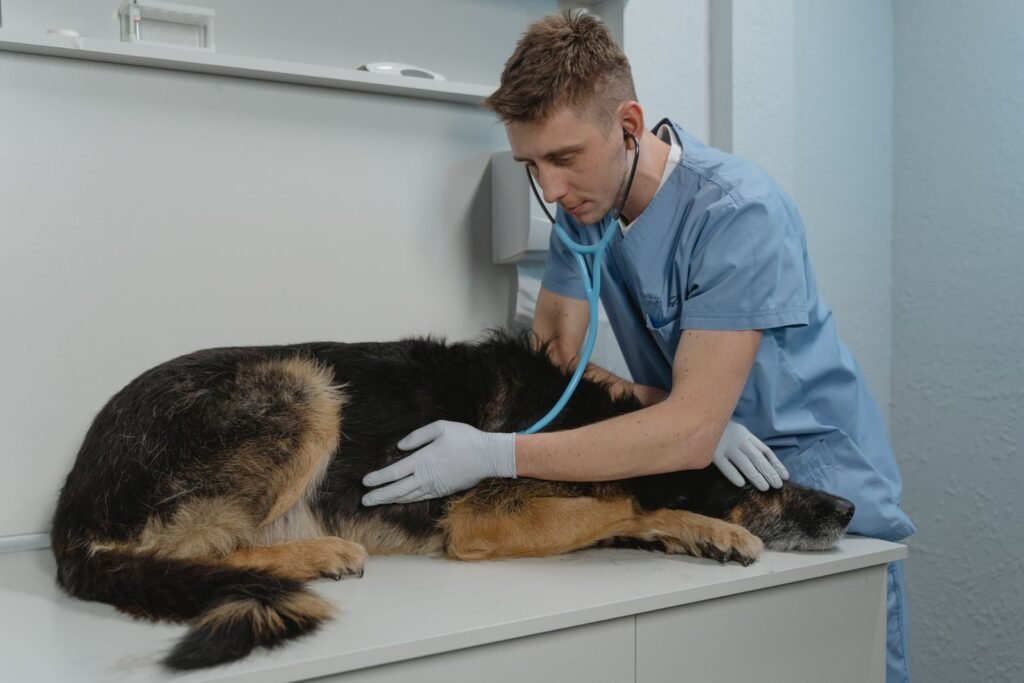
The vet visit cost in the USA is usually $50 to $250 in total for a routine visit, once the exam fee and a few basic add-ons are counted. The exam fee alone is the smaller part: CareCredit, citing the Synchrony Average Procedural Cost Study, puts the national average routine visit at $56 to $129 for a dog and $57 to $130 for a cat. A sick visit with tests often lands between $100 and $400 or more, and an emergency visit starts higher still. Those are national averages, not quotes — your clinic’s written estimate is the only accurate price for your pet, and prices vary by state, clinic type and what your pet needs that day.
What the exam fee covers — and what it does not
The exam fee pays for the veterinarian’s time and a nose-to-tail physical: weight, heart and lungs, eyes, ears, teeth, skin and belly, plus a talk about prevention. Everything else on the invoice is usually a separate line. That is why two owners can both have a “vet visit” and pay very different amounts — one leaves after the exam, the other leaves after the exam plus vaccines, bloodwork and a fecal test.
Webvet’s vet-reviewed 2026 guide puts the exam fee alone at $50–$100 for a dog and $40–$90 for a cat, which lines up closely with the CareCredit/Synchrony averages above. The difference between the two sources is a reminder to read ranges as planning numbers: a $60 exam in one state can be a $120 exam in another. CareCredit’s state table, for example, runs from about $58 in states such as Arkansas and Kansas to $94 in California and $127 in Hawaii.
Vet visit cost for a dog vs a cat
Routine prices for dogs and cats are closer than most owners expect. The exam itself is almost the same price; the bill grows differently because dogs are usually larger (so medication doses cost more) and because their vaccine and prevention schedules differ.
| Type of visit | Dog (typical 2026 range) | Cat (typical 2026 range) |
|---|---|---|
| Routine wellness exam, fee only | $50–$100 | $40–$90 |
| Routine visit, national average (CareCredit/Synchrony) | $56–$129 | $57–$130 |
| Puppy/kitten first visit, with starter shots | $100–$350 | $90–$300 |
| Annual adult checkup, with core vaccines | $100–$300 | $90–$250 |
| Sick visit, with diagnostics | $100–$400+ | $100–$400+ |
| Emergency exam, average (CareCredit/Synchrony 2025 study) | $135 (range $107–$246) | $143 (range $113–$260) |
Sources: Webvet, July 2026, vet-reviewed; CareCredit (Synchrony / ASQ360 2025 cost study), updated 1 May 2026. A first visit for a puppy or kitten is the most variable routine bill, because it bundles the exam with a starter set of shots — and, often, a fecal test and deworming.

Large breeds show the size effect clearly. A German Shepherd, for example, needs larger medication doses and more food, and its breed health watch-points — hip dysplasia screening, bloat awareness — mean vet costs run higher than for many smaller breeds. Read the breed picture in our guide to German Shepherd lifespan before you budget for one.
What a sick visit adds to the bill
When a pet is ill, the exam is only the start. Common add-ons, each billed separately, include bloodwork, X-rays, a fecal exam ($25–$75, according to Adopt-a-Pet’s 2026 guide), urinalysis and medication. That is how a $70 exam becomes a $250 sick visit, and how a visit with imaging can pass $400.
Emergency care is a different scale again. The emergency exam averages $135 for a dog and $143 for a cat, but an exam plus X-rays and basic bloodwork comes to about $737 for a dog and $676 for a cat at average prices, before any medication, fluids or an overnight stay (RexVet, 2026, working from CareCredit national averages). A night in a 24-hour emergency hospital averages $1,323 for a dog ($1,144 for a cat), roughly twice a regular clinic’s overnight rate, so a dog kept overnight at the emergency hospital comes to about $2,060 in total (USA Discount Pet Care, checked 5 Nov 2026). A complex case with surgery and a few days in hospital can climb past $5,000. Insurance claims tell a calmer story — the average emergency claim is about $653 for dogs and $919 for cats (Pumpkin claims data, 2022–2025, as reported by Bo & Boots) — but the range is the point: budget for the exam, and keep a reserve for the workup.
See a vet now if… your pet is retching without bringing anything up with a swollen, tight belly, has collapsed or cannot stand, is suddenly very weak, is bleeding heavily, or shows sudden severe pain or trouble breathing. This is general information only, not a substitute for veterinary advice. Do not try to treat these signs at home — contact a vet or emergency clinic immediately. No drug dosages or treatment instructions are given in this article.
Vet visit cost without insurance
Most vet visits in the USA are paid without pet insurance, so the “without insurance” price is simply the full price on the invoice — there is no separate uninsured rate. What changes without insurance is who carries the risk of a big bill. A routine year is predictable: an adult dog’s yearly visit with the fecal and heartworm tests and the vaccines due that year comes to about $260–$375 at national averages, and a cat’s yearly visit with core vaccines is about $150–$225. An emergency is not predictable, which is why Rover’s 2026 survey found 38% of pet parents could not cover an emergency vet visit without going into debt, and only 10% had a savings account set aside for pet expenses.
Ways owners commonly lower the bill without cutting corners on care:
- Ask for a written estimate before tests and treatment. Clinics expect this, and it stops a $100 visit turning into a $400 surprise.
- Compare the same visit, not just the exam fee. One clinic’s $50 exam with $90 of add-ons is not cheaper than another’s $80 exam that includes the fecal test.
- Use community and nonprofit clinics for routine care. Private clinics tend to cost more than community or nonprofit options, according to vets quoted by Adopt-a-Pet.
- Keep prevention up to date. Heartworm, flea and tick prevention and core vaccines are cheaper than treating the diseases they prevent.
- Plan the first year separately. A puppy or kitten’s first year bundles the most visits — starter shots, spay/neuter, microchip — so it costs more than any later routine year. The full first-year picture is in our guide to the cost of owning a dog.
Pet insurance does not make a visit free; it reimburses part of the bill after you pay, usually after a deductible, and routine wellness cover is often a separate add-on. The North American Pet Health Insurance Association (NAPHIA), in its 2026 State of the Industry Report, puts the average accident-and-illness premium at about $836 a year for a dog (roughly $70 a month) and $435 a year for a cat (roughly $36 a month); accident-only plans average about $190 a year for a dog and $112 for a cat. A different cut of the same NAPHIA data, reported by Pets Best, gives about $62 a month for a dog and $32 for a cat, and Insurify’s June 2026 analysis of more than 250,000 real quotes found a median of $43 a month for a dog and $23 for a cat — the gap is the difference between an average across all ages and breeds and a typical policy for a younger pet. Whether insurance pays for your pet depends on the premium, the deductible and how often your pet needs care — compare those three numbers, not the monthly premium alone.
Vet visit cost near me: why the same visit costs more in some places
Location is the biggest single driver after what the visit includes. CareCredit’s state averages for a routine dog visit run from about $57–$58 in Mississippi, West Virginia, Arkansas and Kansas to $94 in California and $127 in Hawaii. Cities cost more than rural areas, emergency and specialty hospitals cost more than general-practice clinics, and after-hours visits carry an emergency premium on top of the exam fee.

To find the real price near you, call two or three clinics and ask the same question: “What is the exam fee, and what does a routine adult checkup with core vaccines usually total?” Ask whether the visit fee is charged on top of procedure prices, and whether they offer a wellness plan that bundles the year’s routine visits. A clinic that answers plainly is usually a clinic that bills plainly.
FAQ
How much does a vet visit cost for a dog?
A routine visit averages $56–$129 (CareCredit/Synchrony), and most routine visits total $50–$250 once add-ons are counted. A sick visit with diagnostics is often $100–$400 or more.
How much does a vet visit cost for a cat?
A routine visit averages $57–$130 (CareCredit/Synchrony), with the exam fee alone commonly $40–$90. A cat’s yearly visit with core vaccines is about $150–$225.
How much does a vet visit cost without insurance?
The same as the full invoice price — there is no separate uninsured rate. Without insurance you pay the whole bill yourself, so a written estimate before tests and treatment matters most.
How much does an emergency vet visit cost?
The emergency exam averages $135 for a dog and $143 for a cat. With X-rays and basic bloodwork, a typical workup is roughly $680–$740 for a dog, before treatment or an overnight stay.
How much is a vet visit near me?
It depends on your state and clinic type. State averages run from about $57 in the cheapest states to $127 in Hawaii. Call local clinics and ask for the exam fee and the usual total for a routine checkup with core vaccines.
Why is my vet bill higher than the exam fee?
Because vaccines, bloodwork, X-rays, fecal tests and medication are billed separately, on top of the exam fee. Ask for an itemised estimate before agreeing to tests.
Sources
- CareCredit (Synchrony), “How Much Does a Vet Visit Cost?” — https://www.carecredit.com/well-u/pet-care/emergency-vet-visit-cost-and-veterinary-financing/ — routine visit $56–$129 dog, $57–$130 cat (Synchrony Average Procedural Cost Study); emergency exam $135 dog, $143 cat (2025 study by ASQ360, updated 1 May 2026).
- Webvet, “How Much Does a Vet Visit Cost? 2026 Price Guide”, reviewed by a licensed veterinarian, July 2026 — https://www.webvet.com/how-much-does-a-vet-visit-cost/ — exam fee $50–$100 dog, $40–$90 cat; routine visit $50–$250; sick visit $100–$400+.
- Best Money, “How Much Does a Vet Visit Cost? 2026 Price Guide” — https://www.bestmoney.com/pet-insurance/articles/vet-visit-cost — routine checkups $50–$350; dog owners spend roughly $387/year on vet care, cat owners about $217/year (American Pet Products Association data).
- Adopt-a-Pet, “How Much Does a Vet Visit Cost? Average Cost in 2026” — https://www.adoptapet.com/blog/lifestyle/vet-costs-explainer — routine visit $50–$250; emergency visit $150–$5,000 for dogs, $150–$3,000 for cats; fecal exam $25–$75.
- RexVet, “How Much Does an Emergency Vet Visit Cost?” — https://www.rexvet.org/how-much-does-an-emergency-vet-visit-cost-2026-prices-and-when-to-go — exam plus X-rays and basic bloodwork about $737 for a dog, $676 for a cat.
- USA Discount Pet Care, “Emergency Vet Cost” (checked 5 Nov 2026) — https://www.usadiscountpetcare.com/emergency-vet-cost/ — one night in a 24-hour emergency hospital $1,323 dog, $1,144 cat; dog’s one-night ER bill about $2,060.
- Bo & Boots, “What an Emergency Vet Visit Really Costs” (31 May 2026) — https://www.boandboots.com/vet-costs/ — average emergency claim about $653 for dogs and $919 for cats (Pumpkin claims data, 2022–2025).
- NAPHIA — State of the Industry Report 2026, as reported by Pets Best (https://www.petsbest.com/blog/pet-insurance-cost-2026) and PetsAddicters — accident-and-illness premium about $836 a year for a dog (about $70 a month) and $435 a year for a cat (about $36 a month); accident-only about $190 dog, $112 cat. Pets Best reports about $62 a month for a dog and $32 for a cat from the same NAPHIA data; Insurify (June 2026, 250,000+ quotes) reports a median of $43 a month for a dog and $23 for a cat.
Last reviewed: 15 November 2026. This article is general information only and is not a substitute for veterinary advice.