
The best food for puppies is a formula that carries an AAFCO statement for growth, with at least 22.5% protein and 8.5% fat on a dry-matter basis, DHA for brain and vision development, and — for a puppy that will grow large — a calcium level held under the 1.8% large-breed cap. Puppy food is not a marketing trick: compared with adult food, it has more calories per cup, more protein for building muscle, and the calcium and phosphorus balance a growing skeleton needs. Feed an adult formula to a puppy and you risk slow growth, weak bones, and a dog that never reaches its full size, as The Dog Dish Blog’s 2026 guide puts it.
Best food for puppies at a glance (2026)
| Puppy size (expected adult weight) | What to buy | Example formulas named in 2026 guides |
|---|---|---|
| Small, under 20 lb | Puppy formula for small breeds | Purina Pro Plan Puppy (Chicken & Rice) |
| Medium, 20–50 lb | Puppy formula, growth statement | Hill’s Science Diet Puppy |
| Large or giant, over 50 lb | Large-breed puppy formula, calcium capped at 1.8% | Royal Canin Large Puppy; Purina Pro Plan Large Breed Puppy |
Prices from The Dog Dish Blog’s 2026 guide: Purina Pro Plan Puppy $55 to $70 for a 34-pound bag, Royal Canin Large Puppy $75 to $95 for a 30-pound bag, and Hill’s Science Diet Puppy $50 to $65 for a 24-pound bag. They are examples of formulas that fit the criteria in this guide, not a vet’s prescription for your puppy.
Why puppy food is different from adult food
A puppy is not a small adult dog. It doubles or triples its weight in a matter of weeks, and every spoonful has to carry the load, as PuppySimply’s 2026 guide puts it. AAFCO, the body that sets pet-food nutrient standards, publishes two profiles for dog food, and a growing puppy is held to the higher one: for growth, protein has to be at least 22.5% once you remove the water (the dry-matter basis), against 18% for an adult, and fat at least 8.5%, against 5.5%, according to PetScored. Most good puppy foods run higher still — 26 to 32% protein, according to The Dog Dish Blog.
Three ingredients in the bowl do specific jobs. Protein builds muscle. DHA, an omega-3 fatty acid usually listed as fish oil, supports brain and vision development. And the calcium-to-phosphorus ratio builds the skeleton — which is why the numbers on the bag matter more than the picture on the front. A food that says “all life stages” is allowed for a puppy only if its AAFCO statement includes growth; check the statement, not the marketing line.
The large-breed rule: calcium and controlled growth
If your puppy will grow large, read this part first — it is the one place where the wrong food can do lasting harm. Large and giant breed puppies are not simply bigger versions of small breed puppies: their bones, joints, cartilage and growth plates face greater mechanical stress because of rapid growth and substantial adult body weight, according to PurrsMcBarkin’s 2026 review of veterinary nutrition research.
The rule is calcium. Unlike adult dogs, puppies cannot regulate how much calcium they absorb from their intestines — if the diet is too high in calcium, their bodies absorb the excess, and the overabundance leads to rapid bone growth that outpaces the supporting tissues. The result is developmental orthopedic disease: hip dysplasia, osteochondrosis and hypertrophic osteodystrophy. AAFCO defines large-size dogs as those expected to reach 70 pounds or more as mature lean adults, and for formulas fed to large-size puppies it caps calcium at 1.8% on a dry-matter basis, with a minimum of 1.2%. The Merck Veterinary Manual puts it bluntly: excessive calcium above 3% on a dry-matter basis causes more severe osteochondrosis and decreased skeletal remodeling in young, rapidly growing large-breed dogs.
The practical shortcut is the AAFCO statement itself: for a large-breed puppy, look for a food whose adequacy statement reads “including growth of large size dogs (70 lb or more as an adult)”. A food can only make that claim if its maximum calcium is 1.8% or less, according to PetScored. The second rule is controlled growth: overnutrition — excess calories that lead to fast weight gain — is linked to higher risks of developmental orthopedic disease, so the goal is steady, moderate growth, with a body condition score around 4 to 5 out of 9 during growth, according to PurrsMcBarkin. Our guide to golden retriever puppies covers a breed where this matters from the first month, and our german shepherd lifespan guide explains why a large breed’s joints deserve the caution.
How much should I feed my puppy?
The bag’s feeding chart is a starting point, not a rule. Puppies vary, and the right amount is the one that keeps your puppy lean — you should be able to feel the ribs easily under a thin layer of fat, and see a waist when you look down at your puppy, according to The Dog Dish Blog. Weigh your puppy every two weeks and adjust: if the ribs disappear under fat, cut back by 10%; if the ribs stick out, add 10%.
Typical daily amounts for a puppy food at about 400 calories per cup, from The Dog Dish Blog’s 2026 guide:
| Expected adult weight | 8–12 weeks | 3–6 months | 6–12 months |
|---|---|---|---|
| Under 20 lb (small breed) | 1/2–1 cup | 3/4–1 1/2 cups | 1–2 cups |
| 20–50 lb (medium breed) | 1–2 cups | 2–3 cups | 2–3 1/2 cups |
| Over 50 lb (large breed) | 2–3 cups | 3–5 cups | 4–6 cups |
PuppyWhisper’s 2026 feeding chart gives the same shape: a large-breed puppy at 6 to 9 months eats 4 to 6 cups a day, and at 9 to 12 months 4 to 7 cups. Most puppies need about 2 to 3 times more calories per pound of body weight than adult dogs, split across 3 to 4 meals a day under 6 months old.
How often should I feed a puppy? Split the daily amount into 3 to 4 meals a day until your puppy is 6 months old, then drop to 2 meals a day. Petz’s 2026 guide gives the same schedule: 8 weeks to 4 months, 3 to 4 meals a day; 4 to 6 months, 3 meals; 6 months to adulthood, 2 meals. Always refer to the feeding guidelines on your specific brand’s packaging, as calorie density varies widely between brands — and weigh the food with kitchen scales rather than guessing with a cup.

Kibble, wet or fresh: which format suits a puppy?
Dry kibble is the practical default: it provides the properties that keep teeth clean and muscles strong, it fits the necessary nutritional profiles, and it is the cheapest per calorie, according to Hepper’s 2026 feeding guide. Wet food is more palatable and carries more moisture and usually more protein, which helps picky eaters — PuppySimply’s 2026 guide recommends a wet food labelled “complete and balanced” by AAFCO for growth or all life stages, with a named meat first and DHA. Feed about 1 ounce of wet food per pound of body weight daily, split across meals, according to PuppySimply.
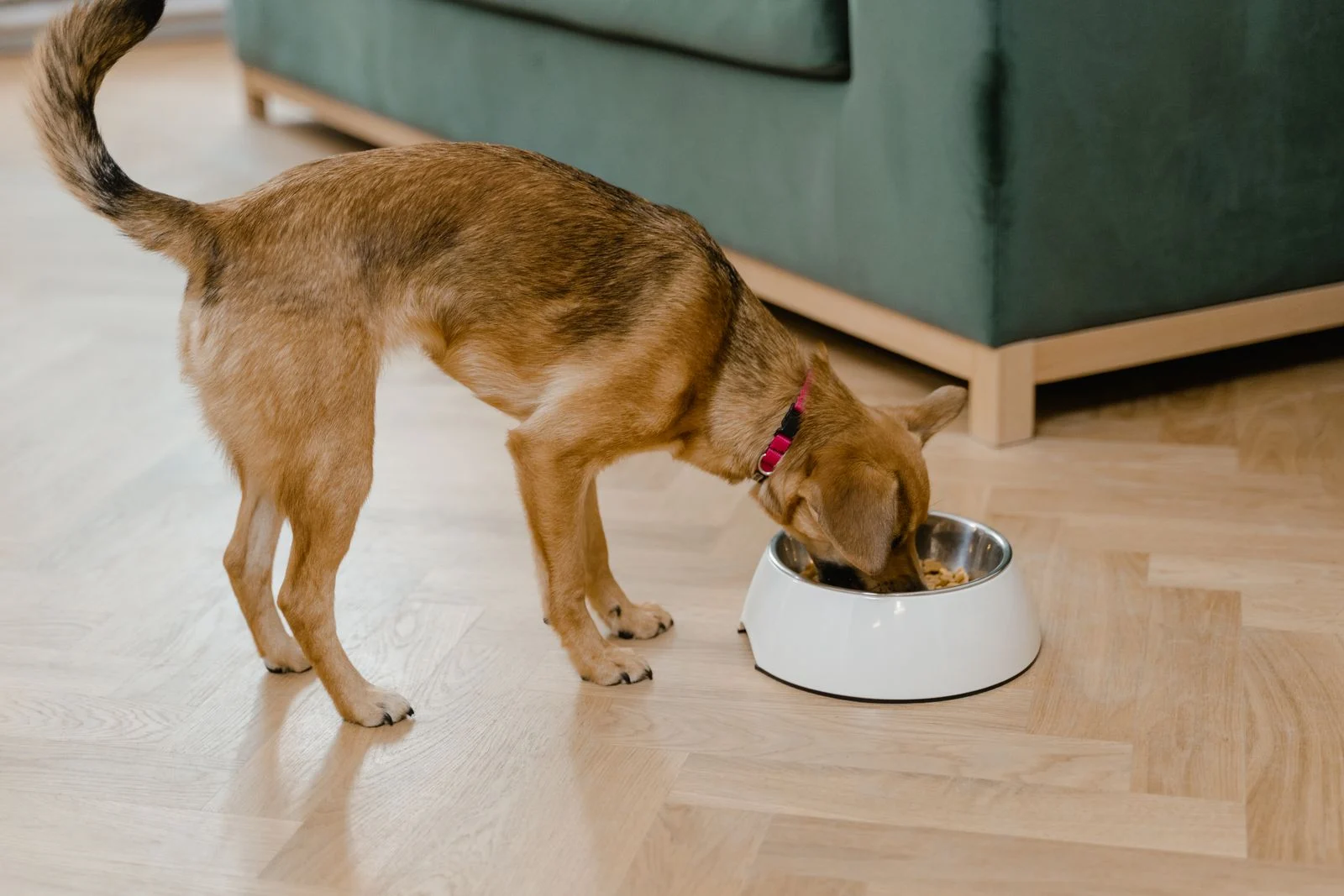
Fresh and frozen puppy diets are the newest option, and the most expensive per day. Whatever the format, the test is the same: an AAFCO growth statement, the right protein and calcium numbers, and a puppy that gains weight steadily rather than fast. A mixed approach works for many owners — kibble as the base, a spoonful of wet food on top for a fussy eater — as long as the total stays measured and the topper does not unbalance the diet.
Weaning, treats and the first vet visits
Most puppies are ready for wet food around three to four weeks, when weaning begins: mix it with warm water or milk replacer, then thin it less each week, and by six to eight weeks they will eat it plain, according to PuppySimply. If you bring a puppy home at eight weeks, it should already be eating solid food — a breeder still offering milk replacer at that age is a warning sign.
Treats are a training tool, not a second meal. Veterinary nutrition guidance commonly keeps treats under 10% of daily calories, and the AAHA 2021 Nutrition and Weight Management Guidelines, as summarised by BreedAdvisor, are the reference most vets use for energy needs. Use tiny, soft treats for training, and count them in the daily total — a handful of large biscuits can quietly add a whole extra meal to a small puppy’s day.
The first year is also the year of vaccines and vet visits: our guide to dog vaccination cost puts the full puppy vaccine series in context, and the cost of owning a dog guide puts food in the yearly budget. A puppy’s first vet visit is the right moment to ask whether its weight and growth rate look right for its breed.
What puppies must never eat
The same toxic foods apply to puppies as to adult dogs, and puppies are more vulnerable because they are smaller and more curious. The ASPCA’s list of people foods to avoid: grapes, raisins, chocolate, onions, garlic, macadamia nuts, alcohol, raw yeast dough and anything with xylitol. Xylitol can drop a dog’s blood sugar within 10 to 60 minutes, according to the FDA, and it hides in sugar-free gum, candy, some peanut butters and even toothpaste. Grapes and raisins can cause kidney damage, with no established safe amount. If your puppy eats something toxic, call your vet or the ASPCA Animal Poison Control Center at (888) 426-4435 right away.
See a vet now if… your puppy is vomiting repeatedly, has diarrhoea with blood, refuses food for more than a day, is suddenly lethargic, or has eaten something toxic. Puppies dehydrate fast — do not wait to see if it passes. This is general information only, not a substitute for veterinary advice.
When should I switch my puppy to adult food?
When growth slows: about 12 months for small breeds, 12 to 14 months for medium breeds, and 18 to 24 months for large and giant breeds, according to The Dog Dish Blog. PuppySimply gives the same shape — small breeds around 9 to 10 months, medium 12 to 14, large 15 to 24 — and Salt et al. (2017), analysing over 8 million vet-measured weight records from Banfield Pet Hospitals, found large-breed dogs do not reach 99% of their adult weight until around 70 weeks, about 16 months.
Switch gradually over seven days to avoid digestive upset and extra weight gain, according to PuppySimply: 25% adult food for two days, then 50%, then 75%, then all adult. The switch is also a good moment to re-check the portion: adult food is less calorie-dense than puppy food, so the cup amount changes even if the dog does not.
FAQ
What is the best food for puppies?
A formula with an AAFCO statement for growth, at least 22.5% protein and 8.5% fat on a dry-matter basis, DHA for brain development, and — for a large breed — a calcium level under the 1.8% cap. Purina Pro Plan Puppy, Hill’s Science Diet Puppy and Royal Canin Large Puppy are the formulas 2026 guides name most often.
How much should I feed my puppy?
Follow the bag’s chart as a starting point: a large-breed puppy at 3 to 6 months eats about 3 to 5 cups a day, a small breed about 3/4 to 1 1/2 cups. Weigh your puppy every two weeks and adjust by 10% either way.
How often should I feed a puppy?
Three to four meals a day until 6 months old, then two meals a day. Never feed a puppy once a day.
What is the best puppy food for large breed puppies?
A large-breed puppy formula whose AAFCO statement reads “including growth of large size dogs (70 lb or more as an adult)” — that phrase guarantees the 1.8% calcium cap. Royal Canin Large Puppy and Purina Pro Plan Large Breed Puppy are the usual examples.
When should I switch my puppy to adult food?
About 12 months for small breeds, 12 to 14 months for medium breeds, and 18 to 24 months for large and giant breeds — and switch gradually over seven days.
What can puppies eat besides kibble?
Wet food labelled complete and balanced for growth, plain cooked chicken or egg in small amounts as treats, and puppy-safe training treats — never chocolate, grapes, onions, xylitol or macadamia nuts.
Sources
- The Dog Dish Blog, “Best Dog Food for Puppies in 2026: 5 Vet-Recommended Picks for Healthy Growth” — http://thedogdishblog.blogspot.com/2026/11/best-dog-food-for-puppies-in-2026-5-vet.html — protein 26–32%; feeding table by age and size; prices (Pro Plan Puppy $55–$70/34 lb, Royal Canin Large Puppy $75–$95/30 lb, Hill’s Puppy $50–$65/24 lb); 3–4 meals until 6 months, then 2; switch to adult at 12 months (small), 12–14 (medium), 18–24 (large/giant).
- PetScored, “Puppy food: what the label has to prove” — https://www.petscored.com/editorial/puppy-food-what-the-label-proves — AAFCO growth profile protein min 22.5%, fat min 8.5% (dry matter); adult 18% and 5.5%; large-breed calcium cap 1.8%; “including growth of large size dogs (70 lb or more as an adult)”.
- PurrsMcBarkin, “Large Breed and Giant Breed Puppies: Why Calcium, Phosphorus, and Controlled Growth Matter Most” — https://blog.purrsmcbarkin.com/large-breed-puppy-nutrition-calcium-phosphorus/ — AAFCO large-size definition 70+ lb; calcium min 1.2%, max 1.8% for large-size puppy formulas; controlled growth; body condition score 4–5 out of 9.
- Amazing Service Dogs, “Large Breed Puppy Food Calcium: Why the Ceiling Matters” — https://amazing-service-dogs.com/large-breed-puppy-food-calcium/ — Merck Veterinary Manual on excess calcium above 3% dry matter worsening osteochondrosis; calcium 3.0–4.5 g per 1,000 kcal for large-size puppies.
- PuppyWhisper, “How Much to Feed a Puppy: The Complete 2026 Feeding Chart” — https://puppywhisper.com/how-much-to-feed-a-puppy/ — feeding chart by age and weight; 2–3 times more calories per pound than adults; large-breed calcium and controlled growth; switch at 18–24 months for large breeds.
- Petz, “Best Puppy Food UK 2026: Top Dry, Wet & Raw Brands Reviewed” — https://www.petz.uk/best-puppy-food/ — meal frequency by age; switch to adult at 80–90% of fully grown weight.
- PuppySimply, “10 Best Wet Foods for Growing Puppies in 2026 + Feeding Guide” — https://puppysimply.com/wet-food-for-growing-puppies/ — weaning at 3–4 weeks, plain food by 6–8 weeks; 1 oz wet food per pound daily; switch over seven days; AAFCO complete and balanced for growth.
- Hepper, “Puppy Feeding Guide & Chart 2026 — How Much & How Often” — https://articles.hepper.com/puppy-feeding-guide/ — feeding chart by weight and age; kibble vs wet food; three meals a day for the first 6 months.
- BreedAdvisor, “How Much Should I Feed My Dog, and How Often?” — https://breedadvisor.com/how-much-should-i-feed-my-dog/ — AAHA 2021 Nutrition and Weight Management Guidelines; energy requirement calculations.
- Spot & Tango, “What Human Food Can Dogs Eat? Safe and Toxic Foods List” — https://www.spotandtango.com/blog/what-human-food-can-dogs-eat — ASPCA list of foods to avoid; xylitol blood-sugar drop within 10 to 60 minutes (FDA); ASPCA Animal Poison Control Center (888) 426-4435.
Last reviewed: 15 November 2026. This article is general information only and is not a substitute for veterinary advice.