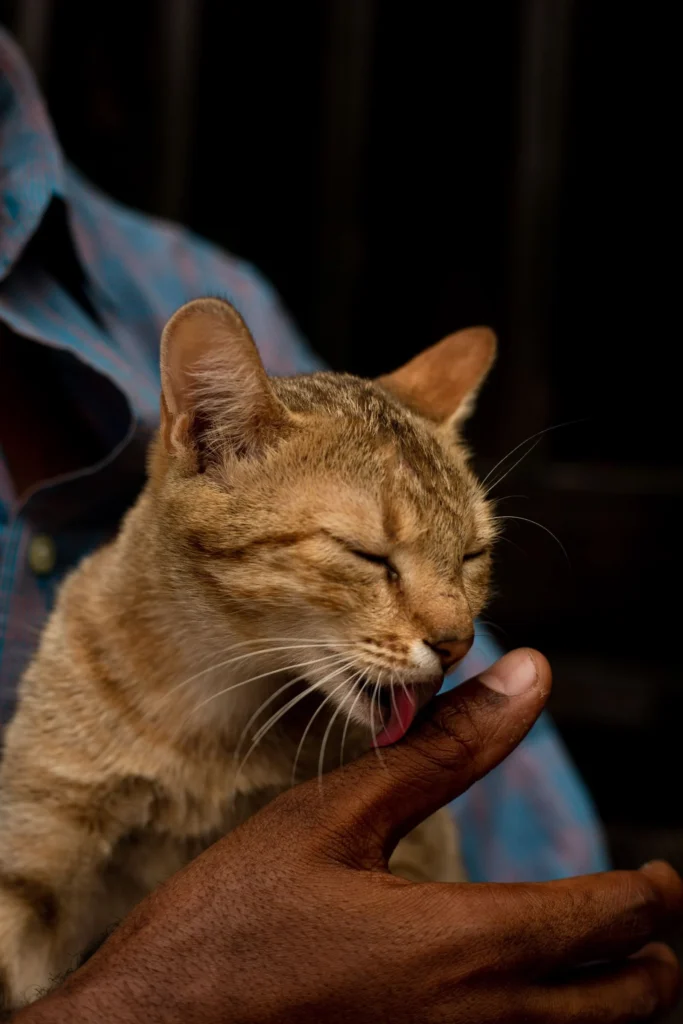
Why does my cat lick me? In most cases, because you are family. Cats groom the people they trust, and a lick is one of the highest compliments a cat can pay: your cat is treating you the way it treats a littermate or a long-time housemate. It is not one single message, though. The same tongue can mean affection, scent-marking, a request for attention, simple curiosity about a taste on your skin — or, when the licking turns frantic or fixated, that something is wrong. This guide explains the seven usual reasons, why the tongue feels like sandpaper, why a lick sometimes turns into a small bite, and the warning signs that mean a vet visit.
Why does my cat lick me — the short answer
| Question | Short answer |
|---|---|
| Why does my cat lick me? | Usually social grooming — affection, bonding and scent-marking someone it trusts. |
| Is it normal for cats to lick their owners? | Yes. Cats groom their preferred people, just as they groom cats they live with. |
| Why does my cat lick my hands? | Taste, scent and attention — hands carry salt, food smells and lotions, and licking gets a reaction. |
| Why does my cat lick my face? | The same bonding behaviour, aimed at the closest, warmest spot — often first thing in the morning. |
| Why does my cat lick me and then bite me? | Grooming escalation or overstimulation — small nibbles are part of grooming between cats, and too much petting can flip a relaxed cat to irritated. |
| Why does my cat lick me so much? | Usually habit and bonding, but sudden, constant or single-spot licking needs a vet check. |
| Should I let my cat lick me? | A lick on healthy skin is fine for most people. Do not let a cat lick an open wound, and wash your hands afterwards. |
First, the tongue itself: why it feels like sandpaper
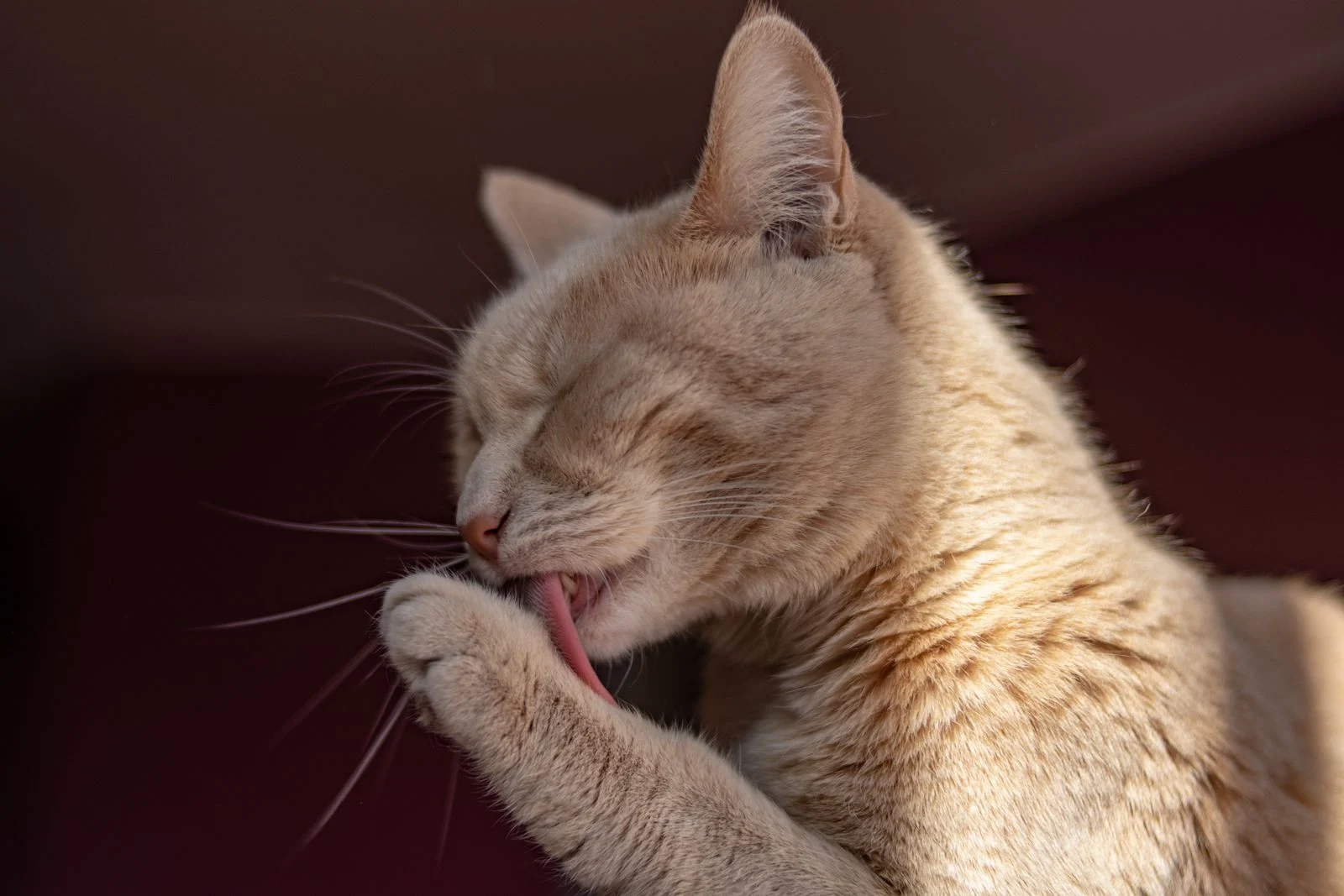
A cat’s tongue is a grooming tool before it is anything else. It is covered in about 300 backward-facing spines called papillae, made of keratin — the same tough protein as claws and fingernails. Research from the Georgia Institute of Technology, using micro-CT scans, found these spines are not solid cones as long assumed, but scoop-shaped, with a tiny U-shaped cavity at the tip that holds saliva and drags it down to the skin. That is why a lick feels rough, why cats are so good at cleaning their own fur, and why being licked feels so different from being licked by a dog.
Cats use that tool constantly. The Cornell Feline Health Center says cats typically spend 30 to 50 percent of their waking hours grooming themselves. Self-grooming is maintenance. Licking another cat — or you — is something else: it is social. Behaviourists call it allogrooming, one animal grooming another, and it starts at birth, when a mother cat licks her newborns to clean them, stimulate breathing and, for the first weeks, trigger toileting. That first grooming forms the kitten’s very first social bond, and the association between licking, comfort and safety stays with the cat for life.
The 7 reasons your cat licks you
1. Affection and bonding
This is the most common reason, and the simplest. Cats only allogroom their preferred individuals — littermates, long-term housemates and the humans they trust. When your cat licks your hand after a nap, or settles on your lap and starts grooming your arm, it is extending to you the same care it learned from its mother. Grooming releases calming endorphins, so it soothes the cat as much as it flatters you. If your cat licks you, take it as a compliment: you are being treated as part of the social group.
2. Scent-marking: you are being claimed
Cats identify group members by a shared smell, built up from grooming, rubbing and sleeping in contact. Licking you deposits your cat’s scent and picks up yours. In the wild, cats that live together develop a group scent that tells them who belongs. When your cat licks you, it may be doing the same thing — marking you as family, and telling other cats that you are spoken for. This is also why cats often focus on the head, neck and ears when they groom each other: those are the spots an individual cannot easily reach alone.
3. Attention — the lick is a button
Many cats learn that a wet swipe gets a reaction: talk, a lap, a treat, a game. The lick becomes a button they can press. If you always respond — even by laughing, talking back or pushing the cat gently away — the cat has learned that licking works. This is not manipulation in the human sense; it is ordinary learning. A cat that licks you at the same time every evening, usually near the kitchen or the treat cupboard, is probably asking for something specific.
4. Taste and curiosity
Sometimes the reason is unglamorous. Salt from sweat, the residue of hand cream, or the smell of whatever you last cooked will all draw a cat’s tongue. Cats are drawn to interesting tastes on skin, and hands and faces carry the most of them. Be careful with scented lotions and creams: some contain ingredients that are not safe for cats, and the US Food and Drug Administration lists xylitol among items that can harm pets, so check the label of anything you put on skin your cat likes to lick, and keep medicated creams away from cats entirely.
5. Self-soothing when stressed
Grooming is rhythmic and calming for the groomer, and cats often groom a person during the wind-down before sleep for the same reason they knead. Cornell notes that licking can be a displacement behaviour when a routine breaks — a move, a new pet, a schedule change, building work next door. If your cat has started licking you far more than usual after a change at home, the licking may be the cat calming itself down, not a new burst of affection. Reducing the stressor, keeping routines steady and adding play usually helps more than stopping the licking itself.
6. “That is enough” — overstimulation
If you pet your cat and it licks you, it may be letting you know it is done with attention. Cats enjoy affection, but each has its limits, and petting the same spot for too long — or touching a sore area — can tip a relaxed cat into irritation. Watch the rest of the body, not just the tongue: a twitching tail, flattened ears, dilated pupils or skin rippling along the back all say the cat has had enough. Stop petting, let the cat walk away, and do not punish the warning lick; it is the polite version of what comes next.
7. Pain, itch or feeling unwell
A sudden jump in licking is not a new love language. Cats lick places on their body that are itchy or painful, and a cat that starts licking you — or itself — far more than usual can be flagging itch, mouth pain, nausea or stomach upset. Licking aimed at one spot on the cat’s own body, rather than at you, is the version of this to watch most closely. If the change is sudden, get it checked rather than assuming it is behavioural: Cornell’s feline experts advise ruling out medical causes before treating overgrooming as a behaviour problem.
Why does my cat lick me and then bite me?
This is one of the most searched follow-up questions, and it has two overlapping explanations. The first is grooming escalation: cats groom each other with teeth as well as tongue, and small nibbles are a normal part of the sequence between cats. Your cat is finishing the grooming job the way it would on another cat. The second is overstimulation, described above: repetitive contact builds arousal, and past a threshold a relaxed cat flips to irritated, in what veterinary behaviour resources describe as petting-induced aggression — one of the most common feline behaviour complaints.
Tell the two apart by the body language around the bite. A soft nibble during a calm grooming session, with a relaxed body and slow blinks, is grooming. A bite that follows tail twitching, ear flattening or skin rippling is overstimulation. Either way, the response is the same: stay calm, stop the interaction, and do not pull your hand away sharply or scold the cat — that teaches the cat that hands are unpredictable, which makes the next bite harder.
When licking becomes a problem: overgrooming
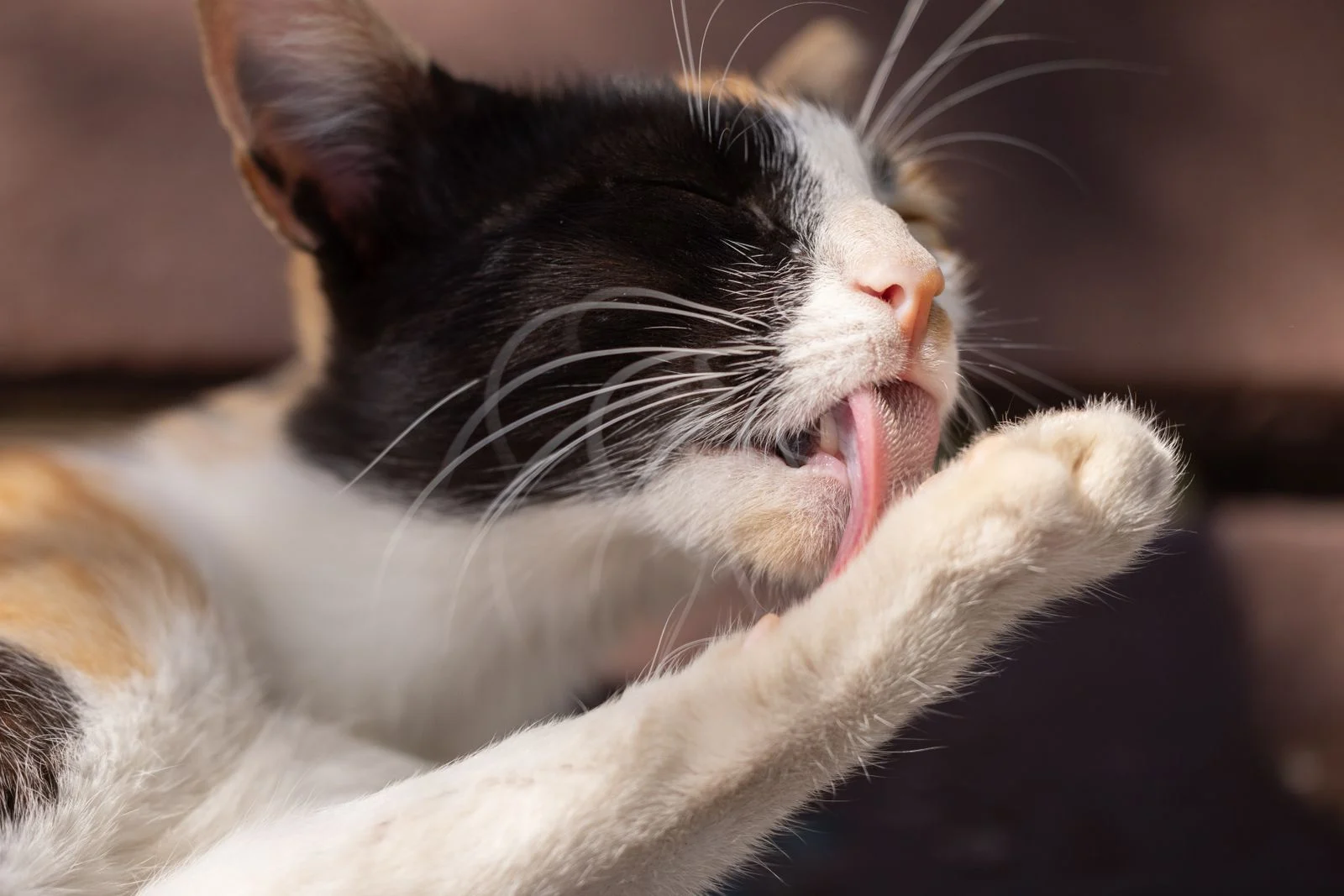
Healthy cats groom for a large part of the day, so long sessions alone are normal and nothing to worry about. The red flag is not time spent; it is physical damage. Overgrooming announces itself on the body, not on the clock:
- Bald patches or thinning fur, often on the belly, inner thighs, or a single leg or paw — the easy-to-reach spots
- Hair that looks broken or barbered short
- Red, raw or irritated skin, scabs or open sores
- Frantic, intense, trance-like licking that is hard to interrupt — versus normal grooming, which a cat happily pauses for food or play
- Licking fixed on one single spot, again and again
Excessive licking has many possible causes, and they are usually medical first: flea allergy dermatitis, food or environmental allergies, mites or lice, joint pain or arthritis, a local injury or inflammation, skin infections, or feline hyperesthesia syndrome, which causes skin sensitivity and sudden grooming frenzies. Stress and boredom can also drive it — overgrooming releases endorphins, creating a calming effect, and stress-related grooming often targets the belly, inner thighs or flanks, and can worsen if the underlying stressor is not addressed. A 2006 case series in the Journal of the American Veterinary Medical Association covered 21 cats sent in for presumed psychogenic alopecia — hair loss assumed to be behavioural — which is a reminder of how easily a medical cause can hide behind a behaviour label.
See a vet now if…
- Your cat has bald patches, sores, scabs or broken skin from licking
- The licking is frantic, constant, or fixed on one spot
- Licking changed suddenly, or comes with vomiting, diarrhoea, appetite loss, hiding or lethargy
- Your cat cries, flinches or reacts in pain when touched in the licked area
- The skin looks infected — spreading redness, swelling, discharge or a bad smell
This guide is general information only and is not a substitute for veterinary advice. Never give a cat medicine, creams or supplements to stop licking without a vet’s direction, and never use a human anti-itch product on a cat.
How to respond to the licks
- If it is affectionate licking: enjoy it, or gently redirect. A calm “enough” and a toy, a treat puzzle or a grooming brush gives the cat something else to do with the same energy.
- If it is attention-seeking: reward quiet moments instead. Respond to the lick once, then wait — answering every lick with play or food teaches the cat to lick more.
- If it is overstimulation: learn your cat’s limit. Shorter petting sessions, watching the tail and ears, and stopping before the lick-bite starts will stretch the limit over time.
- If it is stress licking: keep routines steady, add play and vertical space, and fix the stressor where you can — a new cat introduction done slowly, a quiet hiding place, the same feeding times.
- Do not punish licking. A cat that is punished for grooming you does not learn that licking is rude; it learns that you are unpredictable, and the trust behind the lick is the thing that gets damaged.
- Hygiene basics: wash your hands after a licking session, keep your cat’s flea prevention up to date (see the cat vaccination cost guide linked below), and never let a cat lick an open wound — cats carry bacteria in their mouths that can cause infection in broken skin.
What it is not
One thing a lick is not: dominance. While grooming between cats can carry a status element — a higher-ranking cat will often groom a lower-ranking one around the head and neck — behaviourists are clear that a cat licking a human is read as trust and inclusion, not a power play. Your cat is not trying to dominate you. It is doing the most cat thing there is: treating you as one of its own.
FAQ
Why does my cat lick me?
Usually affection and social grooming. Your cat is treating you as family — bonding, scent-marking and self-soothing, all in one gesture.
Is it normal for cats to lick their owners?
Yes. Cats groom their preferred people just as they groom cats they live with. It is normal feline behaviour, and a sign of trust.
Why does my cat lick my face?
Faces are warm, close and carry your scent. Morning face-licking is often a wake-up call mixed with bonding — the cat wants you up, and wants you to smell like the group.
Why does my cat lick my hands?
Hands carry salt, food smells and lotions, and licking hands reliably gets your attention. It is usually a mix of taste, scent-marking and a request.
Why does my cat lick me and then bite me?
Either grooming escalation — nibbles are part of grooming between cats — or overstimulation from too much petting. Watch the tail, ears and skin: twitching and flattening mean “enough”.
Why does my cat lick itself so much?
Self-grooming takes up 30 to 50 percent of a cat’s waking hours, so a lot of grooming is normal. It becomes a problem only when it causes bald patches, sores or raw skin — then see a vet, because the cause is usually medical first.
Sources
- WebMD — Cat Behavior: What Does It Mean When My Cat Grooms Me? — https://www.webmd.com/pets/cats/features/why-does-my-cat-wash-groom-me%23
- Liger — Why Does My Cat Lick Me? The Real Meaning — https://www.liger.my/en/blog/why-does-my-cat-lick-me-malaysia
- The Pet Bench — What Does It Mean When Your Cat Licks You? 7 Reasons Explained — https://www.thepetbench.com/articles/why-does-my-cat-lick-me/
- Pet Mysteries — Why Does My Cat Lick Me? Your Cat’s Sandpaper Love Language — https://www.petmysteries.com/cats/why-does-my-cat-lick-me/
- Vetic — Why Do Cats Lick Themselves? Causes & When to Worry — https://vetic.in/blog/pet-health/why-do-cats-lick-themselves-understanding-normal-grooming-vs-problem-behaviour/
- Cornell Feline Health Center, “Cats That Lick Too Much” — https://www.vet.cornell.edu/departments-centers-and-institutes/cornell-feline-health-center/health-information/feline-health-topics/cats-lick-too-much — cats typically spend 30–50% of their day grooming (Pamela Perry, DVM); licking focused on an itchy or painful area; rule out medical causes before treating overgrooming as behavioural.
- Waisglass SE, Landsberg GM, Yager JA, Hall JA, “Underlying medical conditions in cats with presumptive psychogenic alopecia”, Journal of the American Veterinary Medical Association, 2006;228(11):1705–1709 — https://pubmed.ncbi.nlm.nih.gov/16740071/ — 21 cats referred for presumed psychogenic alopecia: medical causes of itch found in 16 (76%), only 2 (10%) purely psychogenic, adverse food reaction in 12 (57%).
- Noel AC, Hu DL, “Cats use hollow papillae to wick saliva into fur”, Proceedings of the National Academy of Sciences, 2018;115(49):12377–12382 — https://pmc.ncbi.nlm.nih.gov/articles/PMC6298077/ — Georgia Institute of Technology micro-CT study: scoop-shaped hollow papillae wick saliva into fur; about 300 papillae on a domestic cat’s tongue.
Last reviewed: 15 November 2026. Author: Wafiya Zehra. This article is general information only and is not a substitute for veterinary advice.